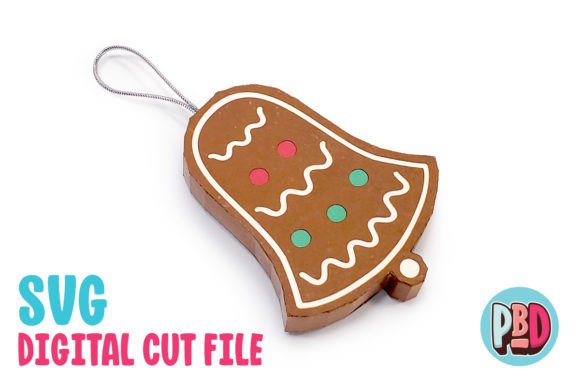
Gingerbread Bell 3D Paper Ornament Review
As a designer who spends half my life in digitizing software and the other half judging whether a finished stitch-out actually looks professional, I approach every new file with a healthy dose of skepticism. The market is flooded with generic holiday clipart, so finding a design that balances aesthetic charm with technical feasibility is rare. Recently, I pulled the Gingerbread Bell 3D Paper Ornament off the shelf to see if it holds up under real-world scrutiny. This isn’t just another static image; it’s a 3D SVG intended for layered construction, which immediately raises the stakes for any embroiderer or crafter looking to incorporate it into their workflow.
My first impression was rooted in its visual personality. The gingerbread bell shape evokes a specific kind of warmth—nostalgic, cozy, and distinctly festive without being overly cluttered. For an Etsy seller or small business owner, this mood is currency. It suggests a product that feels handmade and thoughtful, rather than mass-produced. However, the "3D" aspect implies depth, and in embroidery, depth is often an illusion created by layering, texture, and strategic stitching. If this design is meant to mimic paper ornamentation through thread work, the execution needs to be precise. Does it rely too heavily on dense fills that might pucker the fabric? Or does it use negative space effectively? These are the questions that determine whether a design will succeed in a commercial setting.
Real-World Application: From Screen to Stitch
I decided to test the viability of the Gingerbread Bell 3D Paper Ornament by imagining it on three distinct products: a custom tote bag design for holiday markets, a sweatshirt embroidery piece for boutique branding, and a delicate baby embroidery item like a muslin blanket. Each scenario demands different technical considerations.
For the tote bag design, durability and visibility are key. A gingerbread bell is compact enough to fit comfortably on the side pocket of a canvas tote, but large enough to catch the eye. The challenge here is the background fabric. Canvas is thick and textured, which can eat away at fine details. If the stitch density of the bell’s outline is too high, the needle might struggle to penetrate multiple layers, leading to skipped stitches or thread breaks. Conversely, if the fill stitches are too sparse, the underlying canvas weave will show through, ruining the clean look of the finished product. I would advise using a cut-away stabilizer to support the weight of the fabric and ensure the bell maintains its structural integrity after washing.
When considering sweatshirt embroidery, the focus shifts to comfort and drape. Heavy embellishments on fleece or cotton blends can create uncomfortable lumps. The Gingerbread Bell 3D Paper Ornament seems well-suited for this medium because its geometric simplicity allows for efficient stitching. However, one must be cautious with the "paper" aesthetic. If the design attempts to replicate the crisp edges of paper cutouts using only satin stitches, it may look stiff. A mix of running stitch for outlines and lighter fill stitch patterns for the interior could mimic the texture of gingerbread sugar or icing more naturally. This approach keeps the garment wearable while still delivering a strong visual impact.
The most delicate application would be baby embroidery. Softness is paramount. Here, the embroidery file must be evaluated for potential scratchiness. Dense satin stitches along the edges of the bell could irritate sensitive skin. If this design is intended for baby items, I would recommend reducing the number of passes in the border stitches and opting for a softer thread type, such as rayon or polyester blend, rather than heavy-duty metallics. The nostalgic theme fits perfectly with nursery decor or holiday gifts, but the technical execution must prioritize tactile comfort over sheer detail.
Technical Pitfalls and Fabric Considerations
No design is flawless, and the Gingerbread Bell 3D Paper Ornament is no exception. There are specific scenarios where this design should be used carefully, if at all. First, consider dark fabric. Gingerbread tones are inherently warm browns and tans. On a black or navy background, these colors can disappear unless you use high-contrast thread colors or add a light-colored backing layer. Always test your thread colors against your target fabric before committing to a production run.
Another critical factor is the hoop size. While the dimensions provided suggest a manageable scale (3 W x 0.5 D x 4 H), the actual stitched area may vary depending on the digitization. If the design requires a larger hoop than anticipated, it limits where you can place it on garments. For example, placing a wide design on a curved surface like a cap or hat can result in distortion. The curvature of the cap can stretch the fabric, causing straight lines in the design to bow out. In such cases, pre-curved hooping techniques or specialized caps with built-in hoops are essential.
Textured fabrics present another hurdle. Materials like chenille, velvet, or heavily woven wools can obscure fine details. The embroidery project might lose its definition if the pile of the fabric interferes with the needle’s path. For these materials, simpler designs with fewer small elements perform better. If you are determined to use the Gingerbread Bell 3D Paper Ornament on a textured surface, consider using a water-soluble stabilizer on top during stitching to keep the fabric flat and prevent the needle from catching on loose fibers.
Enhancing Visual Appeal and Brand Consistency
From a branding perspective, the Gingerbread Bell 3D Paper Ornament offers versatility. Its simple silhouette makes it easy to recognize even from a distance, which is crucial for craft fair products or online listings where customers scroll quickly. The "paper" aesthetic also lends itself well to mixed-media projects. You could combine the embroidered element with actual paper cutouts, ribbons, or beads to enhance the 3D effect. This hybrid approach not only adds value to the handmade product but also differentiates it from competitors who offer purely embroidered goods.
For commercial embroidery clients, consistency is king. Using a reliable design like this ensures that every unit produced looks identical. However, variations in thread batches or machine calibration can lead to slight color shifts. To maintain brand integrity, always keep a record of the exact thread numbers used. When creating printable mockups for digital sales, ensure that the lighting and shadows accurately reflect the texture of the embroidery. A flat image might not convey the richness of the stitches, potentially leading to customer dissatisfaction upon receiving the physical item.
Practical Designer Notes for Implementation
Before incorporating the Gingerbread Bell 3D Paper Ornament into your catalog, follow these practical steps to mitigate risk:
- Test on Scrap Fabric: Never go straight to the final garment. Stitch the design on a scrap of the same material to check for puckering, tension issues, and color accuracy.
- Review Stitch Density: Zoom in on the digitized file if possible. Look for areas where stitches overlap excessively, which can cause bulk, or where they are too far apart, which can leave gaps.
- Check Black and White Mockups: Convert your design preview to grayscale. This helps identify contrast issues that might not be obvious in full color. Ensure the bell stands out clearly against the background.
- Inspect Small Details: Examine the smallest elements of the design. Are they legible? Will they survive the washing process? Tiny decorative accents are often the first to fray or break.
- Confirm Licensing: If you plan to sell finished items, verify the license terms of the digital embroidery file. Some licenses restrict commercial use or require attribution. Clear licensing protects your craft business from legal issues.
In conclusion, the Gingerbread Bell 3D Paper Ornament is a charming addition to any holiday collection. It strikes a good balance between thematic appeal and technical manageability, provided that the embroiderer pays attention to fabric choice, stabilization, and stitch quality. For the discerning designer, it offers a solid foundation for creating high-quality, marketable personalized gifts and custom apparel. By approaching the design with a critical eye and rigorous testing, you can transform a simple SVG concept into a standout embroidery project that resonates with customers and elevates your brand.